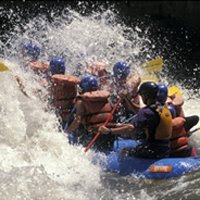
River rafting is a lot of fun. Whitewater river rafting offers thrills, chills, and even an occasional spill. You'll find great river rafting rides in water from Alaska and Colorado to Peru and Fiji. While the wildest rides on many rivers are in the springtime, you can find float trips throughout the summer and early fall, and trips through stronger rapids on rivers that have dam-release water. The generally accepted international grading system puts whitewater river rafting in classes I through VI, with I being the most gentle water and VI promising the most extreme rapids.
1. River Rafting with ROW Adventures
"River Rafting with Row Adventures"Row Adventures
Row Adventures offers more than 30 different trips on 13 rivers, including the Salmon and the Snake rivers in Idaho, the Missouri and Clark Fork in Montana, and the Grande Ronde in Oregon/Washington. The company also offers a trip that includes rafting, mountain biking and hiking, while overnighting at the River Dance Lodge in Idaho.
More Info
2. Finding River Rafting Trip Through Rafting America
Rafting America is a gateway Web site to 20 companies that offer river rafting trips in the United States and Canada. These companies offer half-day to multi-day trips for beginner to experts, on rivers stretching from the Snake River in Utah and the Arkansas river in Colorado, to the Gauley and New rivers in West Virginia. On the Web site's map you can click on the state where you want to go river rafting and company's names may pop up.
More Info
3. River Rafting With Don Hatch River Expeditions
Don Hatch River Expeditions focuses on rivers in the southwestern United States. Rafters can float on the Yampa River that slashes through the canyons within Dinosaur National Park, on the Green River through the Gates of Lodore or the Colorado River through Cataract Canyon.
More Info
4. River Rafting the Royal Gorge with Raft Masters
Rafting the Royal Gorge canyon is one of the top places to go Colorado river rafting. There is no better way to go royal gorge rafting afting with one of the best rafting companies in the US; Raft Masters. As the Arkansas River narrows to only 25-feet wide, this adventure-packed whitewater rafting trip winds its way through the 1,100-foot cliffs of the Royal Gorge. Famous for its steep drops, huge waves, and continuous Class III to Class V whitewater, the spectacular scenery and Royal Gorge's famous rapids thrill even the most experienced whitewater rafting veterans.
More Info
5. River Rafting the Lehigh Gorge with Pocono Whitewater
Pocono Whitewater offers three Lehigh Gorge river rafting trips. The company also offers combination packages, such as Battles & Paddles, which includes a rafting trip and an evening of paintball at Skirmish "Castle Night" event. Another choice is mountain biking the Lehigh Gorge and rafting the Lehigh River.
More Info
6. Wilderness Aware Offers Whitewater River Rafting in Colorado and Arizona
This company, twice named "Colorado Company of the Year," offers raft trips on the Platte, the Delores and the Colorado rivers in Colorado, and the Salt river in Arizona.
7. Some Multi-sport Trips With Austin-Lehman Adventures Include River Rafting
Austin-Lehhman Adventures offers a variety of adventure trips and many include river rafting.
8. River Rafting With Nantahala Outdoor Center
This company runs river rafting trips on nine rivers in Tennessee, Georgia and North Carolina.
9. River Rafting with Oars
Oars offers more than 20 new and classic river rafting trips, in locales from Alaska to Fiji. The company also offers multi-sport trips, such as rafting the Apurimac River, the source of the Amazon and taking a lodge to lodge trek to Machu Picchu.
More Info
10. River Rafting the Grand Canyon With Arizona River Runners
Arizona River Runners offers multi-day river rafting trips on the Colorado River through the Grand Canyon. The company offers a selection of 3- to 8-day motorized adventures and 6- to 13-day oar-powered trips, which can include hiking in or out of the Grand Canyon.
More Info
Showing posts with label Royal Gorge Rafting. Show all posts
Showing posts with label Royal Gorge Rafting. Show all posts
Sunday, February 7, 2010

Friday, July 17, 2009
South Africa River Rafting part II interview featured by Colorado Whitewater Rafting blog
part two of interview with Celliers of South Africa
[W.A.] Do you think it will ever be legal to paddle the Augrabies Gorge? Is there any sort of pressure being put on the park authorities to allow this?

[Celliers] Well, I've paddled it legally a few times. The first time was when I did safety for the Camel Whitewater Challenge in 1999, we ran the section at a few different levels then because we arrived a few days before the river reached the competition water level. I've also run it again in 2001 when we did safety for a movie shoot, this time at a fairly low level. It's quite pushing at any level, really awesome.
Basically, if you can find a good enough reason to paddle the gorge, like doing a movie, it's possible to arrange permission. But if you're talking about legally paddling it any time when you want to, chances are pretty small. It's really a shame, this is a gem of a gorge. There is no sort of pressure being put on the park authorities as far as I know, only requests from a few commercial operators who are keen to take kayakers down the gorge. No luck yet though.
Okay folks, you heard the man. Lets put our thinking caps on. I know! We could make a movie where Kevin Bacon forces us to run the gorge at gunpoint. I'll play Kevin and I need someone to play Meryl. "I am a nice guy. Just a different kind of nice guy."

picture of Fish River
Look Familiar? Its not the Grand Canyon
Fish River Canyon, Namibia
[W.A.] I am intrigued by the Fish river in Namibia (the second largest canyon in the world and a tributary of the Orange). What time of year holds the best chance of running that river?
[Celliers] Only a few guys have ever paddled it. The river only comes up after heavy rain in the catchment area, and as you probably know, the catchment area is pretty much a desert. It will be very difficult to try arrange a paddling trip in the Fish canyon from overseas, unless you have lots of money and can book a ticket the moment the river is up. The rains do come in most years though, but not always at the same time. Bargain on one or two weeks when it will be possible to paddle, any time during our summer.
[W.A.] What other rivers or attractions are worth visiting while in the country?
[Celliers] There are lots of rivers to paddle, but not in the same region as the Northern Cape where the Onseepkans - Pella section is. Most consistent rivers are in KwaZulu-Natal (KZN), where there are all sorts of rivers to choose from. We've recently started to explore previously unrun rivers in the Transkei region and have done a couple of first descents this year. There are still a few rivers waiting for us, but it's very difficult to arrange transport, so it's not something I would recommend for your group. The Lowveld (in the Mpumalanga province) has some really good rivers of a technical nature, but not as consistent as those in KZN. The area around Cape Town has some world class creeks, but they are also very rain dependent and it's a winter rainfall area. There are plenty of attractions, depending on what you're into. Game lodges, ocean surfing, mountaineering, whatever you can think of. I appreciate the interview and I love Colorado River Rafting with all the variety of rapids and scenery too.
Well that wraps it up. I hope to make it to Africa someday and run some of these rivers. As always you can contact Colorado River Rafting with feedback.
[W.A.] Do you think it will ever be legal to paddle the Augrabies Gorge? Is there any sort of pressure being put on the park authorities to allow this?

[Celliers] Well, I've paddled it legally a few times. The first time was when I did safety for the Camel Whitewater Challenge in 1999, we ran the section at a few different levels then because we arrived a few days before the river reached the competition water level. I've also run it again in 2001 when we did safety for a movie shoot, this time at a fairly low level. It's quite pushing at any level, really awesome.
Basically, if you can find a good enough reason to paddle the gorge, like doing a movie, it's possible to arrange permission. But if you're talking about legally paddling it any time when you want to, chances are pretty small. It's really a shame, this is a gem of a gorge. There is no sort of pressure being put on the park authorities as far as I know, only requests from a few commercial operators who are keen to take kayakers down the gorge. No luck yet though.
Okay folks, you heard the man. Lets put our thinking caps on. I know! We could make a movie where Kevin Bacon forces us to run the gorge at gunpoint. I'll play Kevin and I need someone to play Meryl. "I am a nice guy. Just a different kind of nice guy."

picture of Fish River
Look Familiar? Its not the Grand Canyon
Fish River Canyon, Namibia
[W.A.] I am intrigued by the Fish river in Namibia (the second largest canyon in the world and a tributary of the Orange). What time of year holds the best chance of running that river?
[Celliers] Only a few guys have ever paddled it. The river only comes up after heavy rain in the catchment area, and as you probably know, the catchment area is pretty much a desert. It will be very difficult to try arrange a paddling trip in the Fish canyon from overseas, unless you have lots of money and can book a ticket the moment the river is up. The rains do come in most years though, but not always at the same time. Bargain on one or two weeks when it will be possible to paddle, any time during our summer.
[W.A.] What other rivers or attractions are worth visiting while in the country?
[Celliers] There are lots of rivers to paddle, but not in the same region as the Northern Cape where the Onseepkans - Pella section is. Most consistent rivers are in KwaZulu-Natal (KZN), where there are all sorts of rivers to choose from. We've recently started to explore previously unrun rivers in the Transkei region and have done a couple of first descents this year. There are still a few rivers waiting for us, but it's very difficult to arrange transport, so it's not something I would recommend for your group. The Lowveld (in the Mpumalanga province) has some really good rivers of a technical nature, but not as consistent as those in KZN. The area around Cape Town has some world class creeks, but they are also very rain dependent and it's a winter rainfall area. There are plenty of attractions, depending on what you're into. Game lodges, ocean surfing, mountaineering, whatever you can think of. I appreciate the interview and I love Colorado River Rafting with all the variety of rapids and scenery too.
Well that wraps it up. I hope to make it to Africa someday and run some of these rivers. As always you can contact Colorado River Rafting with feedback.
South Africa river rafting edited by Colorado River Rafting
Featured article on Colorado Whitewater Rafting blog
Interview with Celliers Kruger by mania
[W.A.] The Orange seems to be a very long river (2245km). What sections would you recommend if you had two weeks and wanted the best combination of whitewater and scenery?
[Celliers] If you want to do one long trip of two weeks, your best bet will be Onseepkans to Goodhouse. This section goes through the desert, which makes for some awesome scenery. There will be a couple of long flat sections, but there are some very nice rapids (class 3 to 4 mostly) that make it more than worthwhile. The Onseepkans gorge specifically is quite unique. The river splits into two channels a few kilometers downstream of the Onseepkans bridge. The right channel stays fairly flat with one or two nice rapids, while the left channel drop into a gorge with class 4 and 5 rapids. After about two kilometers, just below the biggest rapids of the gorge, the right channel joins the left channel with an unrunnable waterfall. There are still fairly big rapids below the waterfall, really cool.

One thing to keep in mind is that it's always hot here, so it will be difficult to keep food in good shape for two full weeks. An option might be to arrange a re-supply at Pelladrif, roughly halfway.
The Onseepkans gorge has a special place in my heart, my wife and I did our honeymoon on this section. Just the two of us on a two man raft, taking a week to do a trip that normally takes four days. We are actually going back to this area later this month after Christmas to do a trip on the section just above Onseepkans gorge. The river is flatter on this section, but the scenery is still beautiful. We're taking our 15 month baby girl along on our oar raft, so we can't tackle a too difficult section this time.
[W.A.] What time of year would be ideal for optimal flows and temperatures?
[Celliers] The Orange is dam controlled, and all the dams are pretty full at the moment, so a good level can be expected any time of the year if you plan to come in the near future. Temperature wise, autumn and spring will be best. Although I've done an Onseepkans trip in the middle of the winter (July) as well, and it wasn't too cold. The days were actually quite warm, just the nights were a bit chilly.
[W.A.] What kind of experience would you recommend for someone attempting these sections?
[Celliers] If you want to run Onseepkans gorge and don't plan to run the main gorge (most people don't) you will run everything with class 3-4 skills. The river is completely of a pool drop nature with long flat sections, so less experienced paddlers can easily portage the bigger rapids. There are some interesting rapids in the Pella section as well, but nothing more difficult than you'll find below Onseepkans. Remember that this section is not just an adrenaline rush, it's a whole experience.
[W.A.] Tell us a little about the camping, wildlife and side hikes? Any hazards to look out for?
[Celliers] The river runs through a desert so there are not too many big animals. But there are many small animals and lots of different bird species. The fish eagles especially are quite a treat to see and hear. There are many side hikes you can do to explore the side ravines, and you have to climb at least one of the small mountains alongside the river to get a bird's eye view of the area. Apart from the main Onseepkans gorge, which you'll miss completely if you stick to the right channels, there are no serious hazards to look out for. There are also very few people in this area, chances are good that you won't see anybody else during the trip. The people that you do find in this area are always friendly in any case.
[W.A.] Where is the closest international airport? Is it possible to rent equipment and transportation?
[Celliers] You'll fly to either Johannesburg or Cape Town, and then catch a flight to Upington. From there you'll have to arrange shuttles. Remember that public transport is really bad in our country unfortunately, so you'll either have to rent vehicles or arrange your transport beforehand with somebody you know or with commercial operators. It won't be too difficult to get transport arranged though, I'll put you in contact with guys who can do that for you. As for equipment, it is possible to rent, but if it's a big group you might find it difficult to rent everything you need. I would recommend you bring at least all your gear and just rent kayaks here. It will most probably be Fluid kayaks, of course.
Look for part two of this interview soon: Colorado River Rafting Blog
Interview with Celliers Kruger by mania
[W.A.] The Orange seems to be a very long river (2245km). What sections would you recommend if you had two weeks and wanted the best combination of whitewater and scenery?
[Celliers] If you want to do one long trip of two weeks, your best bet will be Onseepkans to Goodhouse. This section goes through the desert, which makes for some awesome scenery. There will be a couple of long flat sections, but there are some very nice rapids (class 3 to 4 mostly) that make it more than worthwhile. The Onseepkans gorge specifically is quite unique. The river splits into two channels a few kilometers downstream of the Onseepkans bridge. The right channel stays fairly flat with one or two nice rapids, while the left channel drop into a gorge with class 4 and 5 rapids. After about two kilometers, just below the biggest rapids of the gorge, the right channel joins the left channel with an unrunnable waterfall. There are still fairly big rapids below the waterfall, really cool.

One thing to keep in mind is that it's always hot here, so it will be difficult to keep food in good shape for two full weeks. An option might be to arrange a re-supply at Pelladrif, roughly halfway.
The Onseepkans gorge has a special place in my heart, my wife and I did our honeymoon on this section. Just the two of us on a two man raft, taking a week to do a trip that normally takes four days. We are actually going back to this area later this month after Christmas to do a trip on the section just above Onseepkans gorge. The river is flatter on this section, but the scenery is still beautiful. We're taking our 15 month baby girl along on our oar raft, so we can't tackle a too difficult section this time.
[W.A.] What time of year would be ideal for optimal flows and temperatures?
[Celliers] The Orange is dam controlled, and all the dams are pretty full at the moment, so a good level can be expected any time of the year if you plan to come in the near future. Temperature wise, autumn and spring will be best. Although I've done an Onseepkans trip in the middle of the winter (July) as well, and it wasn't too cold. The days were actually quite warm, just the nights were a bit chilly.
[W.A.] What kind of experience would you recommend for someone attempting these sections?
[Celliers] If you want to run Onseepkans gorge and don't plan to run the main gorge (most people don't) you will run everything with class 3-4 skills. The river is completely of a pool drop nature with long flat sections, so less experienced paddlers can easily portage the bigger rapids. There are some interesting rapids in the Pella section as well, but nothing more difficult than you'll find below Onseepkans. Remember that this section is not just an adrenaline rush, it's a whole experience.
[W.A.] Tell us a little about the camping, wildlife and side hikes? Any hazards to look out for?
[Celliers] The river runs through a desert so there are not too many big animals. But there are many small animals and lots of different bird species. The fish eagles especially are quite a treat to see and hear. There are many side hikes you can do to explore the side ravines, and you have to climb at least one of the small mountains alongside the river to get a bird's eye view of the area. Apart from the main Onseepkans gorge, which you'll miss completely if you stick to the right channels, there are no serious hazards to look out for. There are also very few people in this area, chances are good that you won't see anybody else during the trip. The people that you do find in this area are always friendly in any case.
[W.A.] Where is the closest international airport? Is it possible to rent equipment and transportation?
[Celliers] You'll fly to either Johannesburg or Cape Town, and then catch a flight to Upington. From there you'll have to arrange shuttles. Remember that public transport is really bad in our country unfortunately, so you'll either have to rent vehicles or arrange your transport beforehand with somebody you know or with commercial operators. It won't be too difficult to get transport arranged though, I'll put you in contact with guys who can do that for you. As for equipment, it is possible to rent, but if it's a big group you might find it difficult to rent everything you need. I would recommend you bring at least all your gear and just rent kayaks here. It will most probably be Fluid kayaks, of course.
Look for part two of this interview soon: Colorado River Rafting Blog
Thursday, July 16, 2009
Colorado River Rafting & India's river rafting
Zanskar River, India... part III completing part I and II
The 7 days river journey on the Zanskar takes you through the Zanskar gorge referred to as the "Grand Canyon" of Asia, through Grade III and Grade IV rapids, much like Colorado River Rafting grade III and IV, which add a dimension of excitement and adventure. A fresh water spring that can be mistaken for a water fall is the lunch point on one of the days. Hikes to monasteries and villages which are otherwise inaccessible all add to the charm of this trip.
The only other way to cross the Zanskar river is in winter when it is frozen and the locals trek across it to cut down their travel time to Leh.

There is always a good chance to spot wild life as we travel along since the area is home to the ibex, mountain goat and snow leopard. The trip ends at Alchi, 60 km, downstream of Leh where our jeeps come to collect us and take us to the comfortable Lha Rimo Hotel in Leh. Two nights in Leh at the end of the trip give you time for last minute shopping in the bazaar and savour a few extra moments in this magical place.
Sample Itinerary
* Day 01 : Fly Delhi / Leh (11,000 ft). Check in at a comfortable hotel in Leh. Relax, don’t exert yourself, your body needs to acclimatise to the altitude.
* Day 02 : Light activity and short walks around Leh. The quaint Leh market is a great place to start exploring as are the numerous bakeries selling mouth - watering gourmet delights. For the more energetic a visit to a few monasteries such as Spituk, Thikse and Hemis will be arranged. Overnight at the hotel.
* Day 03 : We drive 180 km from Leh to Mulbek/Kargil, through a spectacular 'lunar' landscape. Crossing the high mountain pass, Fotu La (14,000 ft), from the Indus valley into the Suru Valley. We visit the Lamayuru monastery en route, known to be one of the oldest monasteries amongst the 'Red Hat' sect. Overnight hotel / PWD Rest House.
* Day 04 : The most spectacular drive filled with natural wonders. We drive to Ringdum Gompa (12,000 ft). Few mountain drives get you this close to the Great Himalaya. The awesome mass of the Nun Kun massif over 7000m high with its hanging glacier across the road from us, dominating today's journey. Overnight in the PWD rest house at Ringdum.
* Day 05 : We drive for approx. 06 hrs to Remala which is the put-in point for the rafting trip. The drive is across the Pensi La at 14,500 ft, at the top of which we stop for lunch surrounded by an awe inspiring arena of the Zanskar peaks at the bottom of which is the Drung Durung glacier that feeds the Zanskar river, 40 km below, on which we begin our rafting trip tomorrow. Overnight tented camp.
* Day 06 : Rafting expedition commences from Remala to Karsha Gompa, near Padum. We cover approx 30 km in 5 hours, which includes a break for lunch and hot beverages. We are surrounded by 6000 m Himalayan and Zanskar peaks. Rapids encountered today are all Class II, a good introduction for first time rafters as well as to the river in general. After settling into camp by 3 PM, take a short walk to Kharsha Gompa for the evening incantations by the monks.
* Day 07 : After breakfast trip starts in the late morning from Kharsha up til Pidmu. This stretch is approximately 30 km with Class II & III rapids. After settling into the camp by mid afternoon, we visit the nearby villages of Pidmu and Hanomil.
* Day 08 : Today we raft approx. 20 km to Nyerak, through Class III rapids and the canyon closes in on us through this gorge section and the views are akin to the Grand Canyon. We make a camp in a steep gorge below Nyerak village.
* Day 09 : Today's rafting stretch is approx. 35 km from Nyerak to Lamaguru. This is the heart of Zanskar. Awe inspiring rock formations with indescribable colours. A good white water day with continuous Class III rapids, with a few Class IV's where the river narrows down to 15 ft in width. We stop for lunch at a huge waterfall at the confluence of Markha river with Zanskar.
* Day 10 : Hiking day today. We hike up the Markha valley to Skiu village to partake of the local culture and colour. Picnic lunch en route. Overnight in Lamaguru camp.
* Day 11 : Rafting from Lamaguru to Nimu today. 40 km on the water through class III / IV white water. The Zanskar joins the Indus river near Nimu. We camp short of the confluence of the two rivers. Overnight.
* Day 12 : Raft approx. 25 km from Nimu to finish the trip at Alchi through class III / IV rapids. After taking out at Alchi, we walk up to the centuries old monastery to view the beautiful frescos and wood carvings. Drive back 60 km to Leh and check in to hotel in Leh.
* Day 13 : In Leh - Rest and relaxation (and those much needed baths !) and time to catch up with any last minute shopping.
* Day 14 : Fly Leh / Delhi.
Go on a Colorado River Rafting expedition or travel to an exotic place to have a new experience if you have the time and funds.
The 7 days river journey on the Zanskar takes you through the Zanskar gorge referred to as the "Grand Canyon" of Asia, through Grade III and Grade IV rapids, much like Colorado River Rafting grade III and IV, which add a dimension of excitement and adventure. A fresh water spring that can be mistaken for a water fall is the lunch point on one of the days. Hikes to monasteries and villages which are otherwise inaccessible all add to the charm of this trip.
The only other way to cross the Zanskar river is in winter when it is frozen and the locals trek across it to cut down their travel time to Leh.

There is always a good chance to spot wild life as we travel along since the area is home to the ibex, mountain goat and snow leopard. The trip ends at Alchi, 60 km, downstream of Leh where our jeeps come to collect us and take us to the comfortable Lha Rimo Hotel in Leh. Two nights in Leh at the end of the trip give you time for last minute shopping in the bazaar and savour a few extra moments in this magical place.
Sample Itinerary
* Day 01 : Fly Delhi / Leh (11,000 ft). Check in at a comfortable hotel in Leh. Relax, don’t exert yourself, your body needs to acclimatise to the altitude.
* Day 02 : Light activity and short walks around Leh. The quaint Leh market is a great place to start exploring as are the numerous bakeries selling mouth - watering gourmet delights. For the more energetic a visit to a few monasteries such as Spituk, Thikse and Hemis will be arranged. Overnight at the hotel.
* Day 03 : We drive 180 km from Leh to Mulbek/Kargil, through a spectacular 'lunar' landscape. Crossing the high mountain pass, Fotu La (14,000 ft), from the Indus valley into the Suru Valley. We visit the Lamayuru monastery en route, known to be one of the oldest monasteries amongst the 'Red Hat' sect. Overnight hotel / PWD Rest House.
* Day 04 : The most spectacular drive filled with natural wonders. We drive to Ringdum Gompa (12,000 ft). Few mountain drives get you this close to the Great Himalaya. The awesome mass of the Nun Kun massif over 7000m high with its hanging glacier across the road from us, dominating today's journey. Overnight in the PWD rest house at Ringdum.
* Day 05 : We drive for approx. 06 hrs to Remala which is the put-in point for the rafting trip. The drive is across the Pensi La at 14,500 ft, at the top of which we stop for lunch surrounded by an awe inspiring arena of the Zanskar peaks at the bottom of which is the Drung Durung glacier that feeds the Zanskar river, 40 km below, on which we begin our rafting trip tomorrow. Overnight tented camp.
* Day 06 : Rafting expedition commences from Remala to Karsha Gompa, near Padum. We cover approx 30 km in 5 hours, which includes a break for lunch and hot beverages. We are surrounded by 6000 m Himalayan and Zanskar peaks. Rapids encountered today are all Class II, a good introduction for first time rafters as well as to the river in general. After settling into camp by 3 PM, take a short walk to Kharsha Gompa for the evening incantations by the monks.
* Day 07 : After breakfast trip starts in the late morning from Kharsha up til Pidmu. This stretch is approximately 30 km with Class II & III rapids. After settling into the camp by mid afternoon, we visit the nearby villages of Pidmu and Hanomil.
* Day 08 : Today we raft approx. 20 km to Nyerak, through Class III rapids and the canyon closes in on us through this gorge section and the views are akin to the Grand Canyon. We make a camp in a steep gorge below Nyerak village.
* Day 09 : Today's rafting stretch is approx. 35 km from Nyerak to Lamaguru. This is the heart of Zanskar. Awe inspiring rock formations with indescribable colours. A good white water day with continuous Class III rapids, with a few Class IV's where the river narrows down to 15 ft in width. We stop for lunch at a huge waterfall at the confluence of Markha river with Zanskar.
* Day 10 : Hiking day today. We hike up the Markha valley to Skiu village to partake of the local culture and colour. Picnic lunch en route. Overnight in Lamaguru camp.
* Day 11 : Rafting from Lamaguru to Nimu today. 40 km on the water through class III / IV white water. The Zanskar joins the Indus river near Nimu. We camp short of the confluence of the two rivers. Overnight.
* Day 12 : Raft approx. 25 km from Nimu to finish the trip at Alchi through class III / IV rapids. After taking out at Alchi, we walk up to the centuries old monastery to view the beautiful frescos and wood carvings. Drive back 60 km to Leh and check in to hotel in Leh.
* Day 13 : In Leh - Rest and relaxation (and those much needed baths !) and time to catch up with any last minute shopping.
* Day 14 : Fly Leh / Delhi.
Go on a Colorado River Rafting expedition or travel to an exotic place to have a new experience if you have the time and funds.
Monday, July 13, 2009
India Whitewater Rafting part II...
by Anupam Chandola
part II of III
Anupam Chandola (Arnie) is a native of India and has guided around the world including the Zanskar
About the History and landscape you would receive on this whitewater expedition in India where Ladakh is in the North.

Located in Northern India, Ladakh is a high altitude desert land abounding in awesome physical features, set in an enormous and spectacular environment comparable to Colorado River Rafting. Bounded by two of the world's mightiest mountain ranges, the Karakoram in the north and the Great Himalaya in the south, it is traversed by two other parallel chains, the Ladakh Range and the Zanskar Range.
For nearly 900 years, from the middle of the 10th century, Ladakh was an independent kingdom, its ruling dynasties descending from the kings of old Tibet. The kingdom attained its greatest geographical extent and glory in the early 17th century under the famous king Singge Namgyal, whose domain extended across Spiti and western Tibet right up to the Mayum-la, beyond the sacred sites of Mount Kailash and Lake Mansarovar.
During the British rule in India, Ladakh, together with the neighboring province of Baltistan, was incorporated into the newly created state of Jammu & Kashmir. Just over a century later, this union was disturbed by the partition of India, as a result of which Baltistan became part of Pakistan, while Ladakh remained in India as part of the State of Jammu & Kashmir. Geographically, Culturally and Politically, Ladakh is completely different from Kashmir. The mighty Zanskar Range forms a natural barrier between the regions of Kashmir and Ladakh.
Today, with political stability, Ladakh is thriving as a Mecca for adventure travelers. Only recently opened by the Indian government to tourism, Ladakh is still relatively untouched by the excesses found in most developing countries.
In the ancient Kingdom of Ladakh the majestic Himalayan ranges, drawing adventure seeking travelers, shape an incredible variety of whitewater challenges for paddlers. A series of worlds most outstanding rivers journeys are found in the Himalayas and Ladakh is no exception. An uncanny blend of natural splendor, exotic cultures, warm weather and exciting whitewater makes river travel in Ladakh especially unique. Adventures in Ladakh are not limited to whitewater excitement. In this fairy tale land of temples, monasteries and medieval villages, a varied and complex culture has evolved rich with distinctive art forms, joyful ceremonies, and deep religious traditions of the ethnic groups that populate the land. Linked by a rich heritage, the people of the Ladakh have created a kaleidoscope of exotic customs and beliefs.
The history and culture of Ladakh only helps deepen the understanding of the land we river raft by, realizing we are just very lucky to a be in very special and ancient place. Colorado River Rafting has the scenery too, but not the heritage and new culture experience and American would be interested in seeing.
part II of III
Anupam Chandola (Arnie) is a native of India and has guided around the world including the Zanskar
About the History and landscape you would receive on this whitewater expedition in India where Ladakh is in the North.

Located in Northern India, Ladakh is a high altitude desert land abounding in awesome physical features, set in an enormous and spectacular environment comparable to Colorado River Rafting. Bounded by two of the world's mightiest mountain ranges, the Karakoram in the north and the Great Himalaya in the south, it is traversed by two other parallel chains, the Ladakh Range and the Zanskar Range.
For nearly 900 years, from the middle of the 10th century, Ladakh was an independent kingdom, its ruling dynasties descending from the kings of old Tibet. The kingdom attained its greatest geographical extent and glory in the early 17th century under the famous king Singge Namgyal, whose domain extended across Spiti and western Tibet right up to the Mayum-la, beyond the sacred sites of Mount Kailash and Lake Mansarovar.
During the British rule in India, Ladakh, together with the neighboring province of Baltistan, was incorporated into the newly created state of Jammu & Kashmir. Just over a century later, this union was disturbed by the partition of India, as a result of which Baltistan became part of Pakistan, while Ladakh remained in India as part of the State of Jammu & Kashmir. Geographically, Culturally and Politically, Ladakh is completely different from Kashmir. The mighty Zanskar Range forms a natural barrier between the regions of Kashmir and Ladakh.
Today, with political stability, Ladakh is thriving as a Mecca for adventure travelers. Only recently opened by the Indian government to tourism, Ladakh is still relatively untouched by the excesses found in most developing countries.
In the ancient Kingdom of Ladakh the majestic Himalayan ranges, drawing adventure seeking travelers, shape an incredible variety of whitewater challenges for paddlers. A series of worlds most outstanding rivers journeys are found in the Himalayas and Ladakh is no exception. An uncanny blend of natural splendor, exotic cultures, warm weather and exciting whitewater makes river travel in Ladakh especially unique. Adventures in Ladakh are not limited to whitewater excitement. In this fairy tale land of temples, monasteries and medieval villages, a varied and complex culture has evolved rich with distinctive art forms, joyful ceremonies, and deep religious traditions of the ethnic groups that populate the land. Linked by a rich heritage, the people of the Ladakh have created a kaleidoscope of exotic customs and beliefs.
The history and culture of Ladakh only helps deepen the understanding of the land we river raft by, realizing we are just very lucky to a be in very special and ancient place. Colorado River Rafting has the scenery too, but not the heritage and new culture experience and American would be interested in seeing.
Monday, July 6, 2009
Colorado River Rafing featuring rafting in India
The Zanskar River :: India
by Anupam Chandola
part I of III
Anupam Chandola (Arnie) is a native of India and has guided around the world including the Zanskar. Arnie really wants to go again so he wrote this up to entice you to join us in the summer for "a true journey of exploration and discovery". He can setup fully guided or semi-private trips where you kayak or row your own raft as I know that would appeal to many of our readers. Just contact us with questions.
Rafting in the Indian Himalayas
River running is virtually as old as civilization itself, but rafting and kayaking as recreational activities are relatively new, especially in the Indian Himalayas. A river journey in an exotic foreign country is one of the most enjoyable and effective ways to experience the rural areas, observing different ways of live, cultures and natural environments, and coming into contact with village people the conventional traveler rarely gets to meet. These pleasures are complimented by an even greater thrill: rafting through powerful, fast flowing rapids. The skills of our professional guides and the stability, sturdiness and buoyancy of modern self bailing rafts, enable us to safely challenge these exciting rivers. Nowhere are these voyages of exploration and adventure better experienced than in the Himalayas, where some of the finest white-water rivers in the world surge through spectacular land of dramatic contrast supporting an amazing variety of flora and fauna, interlaced with a myriad of centuries-old culture. History you will find with India River Rafting in the Himalayas. Colorado River Rafting has more rapids...
by Anupam Chandola
part I of III
Anupam Chandola (Arnie) is a native of India and has guided around the world including the Zanskar. Arnie really wants to go again so he wrote this up to entice you to join us in the summer for "a true journey of exploration and discovery". He can setup fully guided or semi-private trips where you kayak or row your own raft as I know that would appeal to many of our readers. Just contact us with questions.
Rafting in the Indian Himalayas
River running is virtually as old as civilization itself, but rafting and kayaking as recreational activities are relatively new, especially in the Indian Himalayas. A river journey in an exotic foreign country is one of the most enjoyable and effective ways to experience the rural areas, observing different ways of live, cultures and natural environments, and coming into contact with village people the conventional traveler rarely gets to meet. These pleasures are complimented by an even greater thrill: rafting through powerful, fast flowing rapids. The skills of our professional guides and the stability, sturdiness and buoyancy of modern self bailing rafts, enable us to safely challenge these exciting rivers. Nowhere are these voyages of exploration and adventure better experienced than in the Himalayas, where some of the finest white-water rivers in the world surge through spectacular land of dramatic contrast supporting an amazing variety of flora and fauna, interlaced with a myriad of centuries-old culture. History you will find with India River Rafting in the Himalayas. Colorado River Rafting has more rapids...
Friday, July 3, 2009
Colorado River Rafting and what to wear...

You will be the most comfortable in things that dry quickly. If the weather is warm, and that is most typical, dress to get wet. Swimsuits, shorts and T-shirts are fine. Appropriate footwear is a must. Old pair of tennis shoes or the Teva-type sport sandals (the guides choice of footwear) is best. Wool socks or no socks. If it is expected to be a cool day, rule number one is COTTON IS WRONG! A wool sweater or fleece jacket is good to have along on any raft trip. There are brands of wetsuits and one of the best for coldwater 45 degrees is this wetsuit approved by scuba pros and this wetsuit for waters ranging 60 to 75 degrees, spray jackets, and river boots preferred by Colorado River Rafting professionals. Again, expect to get wet!
If you wear glasses or plan to wear sunglasses, a retaining strap such as a chums or croakies is the key to still owning your glasses at the end of the day. Only waterproof cameras are recommended. A water bottle is nice to have along. Most outfitters rent the river wear and some provide certain things for free like raftmasters.com on your Colorado Whitewater Rafting trip. Sunscreen and/or a hat are also good to have. Don't forget your spirit of adventure.
Wednesday, July 1, 2009
Colorado Whitewater Rafting Terminology for beginners
Boat & Equipment Terminology
Paddle: A paddle held in the hands, not attached to the boat, used to paddle. Can be single-bladed (for rafting and canoeing) or double-bladed (for kayaking, solo cats, inflatable kayaks)
Paddle Boat: A raft with a crew of paddlers and a guide.
Oar: A long blade, attached to the boat by an oarlock on thole pin, and used to row.
Oar Rig: A boat rigged with oars, so one person sitting in the center of the boat can row.
Stern Rig, Paddle Assist: An oar/paddle boat, in which the guide has oars and frame in the stern, and thecrew, sitting forward, has paddles. Ofen used on high water.
Bow: The front of the boat.
Stern: The rear of the boat.
Duckie, Inflatable Kayak, Funyak, Splashyak: A one or two person inflatable boat, usually paddled with double bladed paddles.
Cataraft: An inflatable boat with two pontoons.
Solo Cat: A one-person cataraft paddled with a double-bladed paddle.
Hoopi: Tubular webbing used for multiple purposes in rigging and preparing boats. Some into Colorado Whitewater Rafting do not know this term.
Carabiner: A clip, used to secure items into the boat, and to construct safety and rescue systems.
Wet Suit: A neoprene rubber suit which allows a small amount of water in, to help retain body heat.
Dry Suit: A suit designed to keep all water out, under which any amount of layered clothing can be worn.
Dry Bag,
Day Bag: A bag for keeping gear in on the river, to help keep things dry (but probably not 100%)
Life Jacket: A personal floatation device, coast guard approved, and worn like a vest.
Paddle: A paddle held in the hands, not attached to the boat, used to paddle. Can be single-bladed (for rafting and canoeing) or double-bladed (for kayaking, solo cats, inflatable kayaks)
Paddle Boat: A raft with a crew of paddlers and a guide.
Oar: A long blade, attached to the boat by an oarlock on thole pin, and used to row.
Oar Rig: A boat rigged with oars, so one person sitting in the center of the boat can row.
Stern Rig, Paddle Assist: An oar/paddle boat, in which the guide has oars and frame in the stern, and thecrew, sitting forward, has paddles. Ofen used on high water.
Bow: The front of the boat.
Stern: The rear of the boat.
Duckie, Inflatable Kayak, Funyak, Splashyak: A one or two person inflatable boat, usually paddled with double bladed paddles.
Cataraft: An inflatable boat with two pontoons.
Solo Cat: A one-person cataraft paddled with a double-bladed paddle.
Hoopi: Tubular webbing used for multiple purposes in rigging and preparing boats. Some into Colorado Whitewater Rafting do not know this term.
Carabiner: A clip, used to secure items into the boat, and to construct safety and rescue systems.
Wet Suit: A neoprene rubber suit which allows a small amount of water in, to help retain body heat.
Dry Suit: A suit designed to keep all water out, under which any amount of layered clothing can be worn.
Dry Bag,
Day Bag: A bag for keeping gear in on the river, to help keep things dry (but probably not 100%)
Life Jacket: A personal floatation device, coast guard approved, and worn like a vest.
Monday, June 29, 2009
BRECKENRIDGE RAFTING and what rafts utilized by outfitters
INFORMATION ABOUT THE MANUFACTURERS OF RAFTS under 12 feet long and what rafts are used by Breckenridge Rafting outfitters:
AIRE

RAFT:Puma Length:11'6" Width:66" Diameter:18" WEIGHT:88 lbs MATERIAL:PVC/U CAPACITY:950 lbs PRICE:$2500
AIRE makes the Puma, a longtime favorite for raft creeking. Lately they have been making bigger versions of the Puma called the Super Puma and the Super Duper Puma but I feel like they should make a smaller version and call it the Baby Puma or something. Recently I portaged a Puma for three miles and that wasn't too fun. If you are listening AIRE please build me a Baby Puma, 9 feet long and weighing less than 40 lbs.
Hyside

Mini-Me 9' 62" 18" 45 lbs Hyp 4 $1764
140SBU 11'8" 70" 18" 87 lbs Hyp 6 $2779
109RBS 9' 62" 18" 71 lbs Hyp 4 $1420
139RBS 11'6" 66" 18" 84 lbs Hyp 6 $1975
Hyside is the proud maker of the Mini Me 9 foot raft. What fun! These things are popular R2 boats and make it possible to do some serious raft creeking. Made of Hypalon.
Incept

G25S 8'5" 53" 15" 55 lbs Poly/U 2 $NA
G29S 9'6" 57" 15.75" 66 lbs Poly/U 3 $NA
W33S 10'10" 63" 15.75" 78 lbs Poly/U 4 $2190
These New Zealand boats are imported directly to Idaho through a giant whirlpool from the Buller River straight to the Payette. They offer not one but three small rafts in delightfully light weights for those days where half your time is spent walking.
Maravia

Seal 11'6" 72" 17" 77 lbs Poly/U 4 $2201
Elan 12' 69" 18" 95 lbs Poly/U 6 $3998
Maravia makes two small rafts but don't try to find them on the Maravia website - better off visiting the River Connection instead. I was part of a two man crew that paddled a little Maravia down the Green Truss section of the White Salmon and the boat held up very well.
NRS

E-120 12' 66" 17" 108lbs Hyp NA $3400
Otter120 12' 66" 17" 88 lbs Hyp NA $2475
NRS has two 12 foot self-bailing models both made of hypalon. The E series is made for commercial abuse but is pretty heavy. The Otter is a good value and should be a great boat for the private boater.
SOTAR

SP10E (Tan) 10' 18" ? lbs Poly/U ? $2400
SP12E 12' ? 18" ? lbs Poly/U ? $2779
ST11E 11' 62" 19" 78 lbs Poly/U ? $3381
ST12E 12' 70" 19" 85 lbs Poly/U ? $3381
SL11E 11' 64" 20" 75 lbs Poly/U ? $3740
ST12E 12' 68" 20" 82 lbs Poly/U ? $3974
Sotar has three basic raft models. The ST is their standard design, the SP is the standard design but in Tan color only and the ST has a diminishing tube design. The prices are pretty high for boats this small, save perhaps the SP model. Sotars have been used on some pretty balsy stuff including the first raft descent of the Green River Narrows.
Star

LX12-SB THUNDER 12' 72" 18" 116 lbs PVC 3-6 $2449
VX12-SB 12' 72" 18" 90 lbs PVC 6 $1485
B12-SB LIGHTNING BUG 12' 57" 24" 103 lbs PVC 3-5 $1919
U9-SB ULTRA LITE 9' 50" 18" 75 lbs PVC 4 $1675
Star is the maker of the Bug and Ultra Bug as well as standard rafts. The bugs are supposed to behave more like catarafts since they have a lot of clearance. Check it out to see what I mean.
Vanguard

PSB-1104 11'4" 66" 16" 101 lbs PVC 4 $2395
PSB-1200 12' 73" 18" 114 lbs PVC 6 $2595
Vanguard makes two small rafts with a nice price. Unfortunately they are very heavy and would be difficult to carry for just two people.
This information is cited from www.whitewateraddiction.com and many or all Breckenridge Rafting outfitters use these manufacturers.
AIRE

RAFT:Puma Length:11'6" Width:66" Diameter:18" WEIGHT:88 lbs MATERIAL:PVC/U CAPACITY:950 lbs PRICE:$2500
AIRE makes the Puma, a longtime favorite for raft creeking. Lately they have been making bigger versions of the Puma called the Super Puma and the Super Duper Puma but I feel like they should make a smaller version and call it the Baby Puma or something. Recently I portaged a Puma for three miles and that wasn't too fun. If you are listening AIRE please build me a Baby Puma, 9 feet long and weighing less than 40 lbs.
Hyside

Mini-Me 9' 62" 18" 45 lbs Hyp 4 $1764
140SBU 11'8" 70" 18" 87 lbs Hyp 6 $2779
109RBS 9' 62" 18" 71 lbs Hyp 4 $1420
139RBS 11'6" 66" 18" 84 lbs Hyp 6 $1975
Hyside is the proud maker of the Mini Me 9 foot raft. What fun! These things are popular R2 boats and make it possible to do some serious raft creeking. Made of Hypalon.
Incept

G25S 8'5" 53" 15" 55 lbs Poly/U 2 $NA
G29S 9'6" 57" 15.75" 66 lbs Poly/U 3 $NA
W33S 10'10" 63" 15.75" 78 lbs Poly/U 4 $2190
These New Zealand boats are imported directly to Idaho through a giant whirlpool from the Buller River straight to the Payette. They offer not one but three small rafts in delightfully light weights for those days where half your time is spent walking.
Maravia

Seal 11'6" 72" 17" 77 lbs Poly/U 4 $2201
Elan 12' 69" 18" 95 lbs Poly/U 6 $3998
Maravia makes two small rafts but don't try to find them on the Maravia website - better off visiting the River Connection instead. I was part of a two man crew that paddled a little Maravia down the Green Truss section of the White Salmon and the boat held up very well.
NRS

E-120 12' 66" 17" 108lbs Hyp NA $3400
Otter120 12' 66" 17" 88 lbs Hyp NA $2475
NRS has two 12 foot self-bailing models both made of hypalon. The E series is made for commercial abuse but is pretty heavy. The Otter is a good value and should be a great boat for the private boater.
SOTAR

SP10E (Tan) 10' 18" ? lbs Poly/U ? $2400
SP12E 12' ? 18" ? lbs Poly/U ? $2779
ST11E 11' 62" 19" 78 lbs Poly/U ? $3381
ST12E 12' 70" 19" 85 lbs Poly/U ? $3381
SL11E 11' 64" 20" 75 lbs Poly/U ? $3740
ST12E 12' 68" 20" 82 lbs Poly/U ? $3974
Sotar has three basic raft models. The ST is their standard design, the SP is the standard design but in Tan color only and the ST has a diminishing tube design. The prices are pretty high for boats this small, save perhaps the SP model. Sotars have been used on some pretty balsy stuff including the first raft descent of the Green River Narrows.
Star

LX12-SB THUNDER 12' 72" 18" 116 lbs PVC 3-6 $2449
VX12-SB 12' 72" 18" 90 lbs PVC 6 $1485
B12-SB LIGHTNING BUG 12' 57" 24" 103 lbs PVC 3-5 $1919
U9-SB ULTRA LITE 9' 50" 18" 75 lbs PVC 4 $1675
Star is the maker of the Bug and Ultra Bug as well as standard rafts. The bugs are supposed to behave more like catarafts since they have a lot of clearance. Check it out to see what I mean.
Vanguard

PSB-1104 11'4" 66" 16" 101 lbs PVC 4 $2395
PSB-1200 12' 73" 18" 114 lbs PVC 6 $2595
Vanguard makes two small rafts with a nice price. Unfortunately they are very heavy and would be difficult to carry for just two people.
This information is cited from www.whitewateraddiction.com and many or all Breckenridge Rafting outfitters use these manufacturers.
Rafts you will not see often during Colorado Whitewater Rafting

You may come across two other types of rafts during a Colorado Whitewater Rafting expedition that are not used often called J-Rigs, Sweep boats, and Dories. 'J-rigs' are giant rafts that are very specialized passenger and gear haulers. J-rigs are constructed of huge pontoons and are often motorized. They're used by many of the commercial rafting companies in the Grand Canyon. Sweep boats are named for the two huge oars used to steer them. They're basically very large self bailers, but the oars extend out both ends of the craft, and steer the boat like rudders rather than extending out the sides to row as a normal self bailer does.
Sweep boats (or "sweeps") are commonly used by commercial outfitters on the Middle Fork of the Salmon (you'll rarely see them on other rivers). Their advantage is that they carry huge loads of camping gear and food for Colorado Whitewater Rafting expeditions that last longer than a few days.
Due to the huge displacement and surface area exposed to the current, they are the fastest non-motorized craft on the river. Their disadvantage is that they have no brakes! Trust that if you see one, the guide holding those big oars is both very courageous and very skilled!
Dories
While certainly not a raft, you may encounter wooden or fiberglass boats called Dories on the river. These craft seem to be more popular on certain rivers. While they may be more fragile, they are certainly maneuverable.

They seemingly can stop on a dime in significant current, giving their ‘driver’ time to adjust course, mid-rapid. And they are a pretty sporty ride! But on rocky rivers or later in the season at lower water levels a Dorie can be a liability.
Breckenridge Rafting Kayaks

Kayaks
Other forms of Breckenridge Rafting craft are worth mentioning. The obvious one is kayaks. These also come in two flavors; hard shelled kayaks made of various rigid plastics, and 'inflatable' kayaks, also known as "IK's" that are made of the same materials as rafts. Both types of kayaks are a lot of fun and have their vocal advocates. I'll just point out a little bit of trivia.
That is, while both groups share the river, hard shelled kayakers and rafters generally don't intermingle much. They are two different sports that share the same playing field. But some hard shell kayakers shun their inflatable brethren in IKs. So, ironically, inflatable kayakers tend to hang out with the rafters. I guess it's the materials that are alike that bring a kayaker and rafters together in some cases.

Colorado Whitewater Rafting and what is an R2?

What's an ‘R2’?
You might hear the term "R2" mentioned in the context of Colorado whitewater rafting. This refers to a paddle raft being paddled by just two people. They usually sit shoulder to shoulder in the middle of the raft, each paddling a side. Of course, they can sit anywhere they want. The term R2 implies a sportier version of paddle rafting since it is more challenging to maneuver the boat when there are just two people aboard.

R2's came from the idea of kayaks and canoes for the simple reason of wanting something new and ingenuity on the rivers. Of course the R2's come after the larger rafts design for those people who take Colorado Whitewater Rafting to higher levels and extremes compared to a large group on a self bailer for a trip.
Saturday, June 27, 2009
Raft speeds for Colorado River Rafting
Differences in Raft Speed
Most of the paddle strokes that a paddle raft crew takes to steer the raft propel the raft forward. Therefore paddle rafts move down the river faster than other rafts. Self bailers are next fastest. Fully loaded self bailers carry a lot of momentum and offer a lot of surface area to the river. So friction with the water causes them to be dragged along easily by the current. Since it's a lot more work to fight against these factors, the steering strokes that the person at oars takes are usually forward strokes.

The raftman just tries to adjust the direction or vector of the rafts natural movement down the river during Colorado River Rafting. It may be surprising to know that catarafts are usually the slowest at traveling down the river as they offer less surface area for friction and are so light that it is easy for the oarsman to pull back, arresting the momentum. For these reasons, rookie oarsmen in catarafts are usually at the back of any group of rafts.
Most of the paddle strokes that a paddle raft crew takes to steer the raft propel the raft forward. Therefore paddle rafts move down the river faster than other rafts. Self bailers are next fastest. Fully loaded self bailers carry a lot of momentum and offer a lot of surface area to the river. So friction with the water causes them to be dragged along easily by the current. Since it's a lot more work to fight against these factors, the steering strokes that the person at oars takes are usually forward strokes.

The raftman just tries to adjust the direction or vector of the rafts natural movement down the river during Colorado River Rafting. It may be surprising to know that catarafts are usually the slowest at traveling down the river as they offer less surface area for friction and are so light that it is easy for the oarsman to pull back, arresting the momentum. For these reasons, rookie oarsmen in catarafts are usually at the back of any group of rafts.
Paddle Rafts for Colorado Whitewater Rafting
Paddle Rafts
Self bailers can be set up with a rigid metal (or on rare occasions, wood) frame that rests across the top of the raft, to which oar locks are mounted and oars attached. The other configuration is to leave the frame and oars at home and just use paddles. So the term 'paddle raft' refers to this other set up. It's just a term for a self bailer that is set up with inflated seats known as 'thwarts' for passengers to sit on. This image shows set up for both with mounted oars in the back, and in the front people using paddles.

Passengers are obligated to row, or more accurately, paddle the boat down the river. While this means work for the passengers, it makes for a very entertaining, social (and usually wet) ride! Most commercial river guides services for Colorado Whitewater Rafting run paddle boats to give the paying clients the full immersion experience.
The normal configuration for a paddle boat is to have a 'captain' sitting at the rear of the boat shouting orders to the crew and using her paddle to steer or make fine adjustments to speed and direction. The 'crew' is the rest of the passengers, with half of them paddling on one side and the other half paddling on the other making a Colorado Whitewater Rafting experience memorable.
Self bailers can be set up with a rigid metal (or on rare occasions, wood) frame that rests across the top of the raft, to which oar locks are mounted and oars attached. The other configuration is to leave the frame and oars at home and just use paddles. So the term 'paddle raft' refers to this other set up. It's just a term for a self bailer that is set up with inflated seats known as 'thwarts' for passengers to sit on. This image shows set up for both with mounted oars in the back, and in the front people using paddles.

Passengers are obligated to row, or more accurately, paddle the boat down the river. While this means work for the passengers, it makes for a very entertaining, social (and usually wet) ride! Most commercial river guides services for Colorado Whitewater Rafting run paddle boats to give the paying clients the full immersion experience.
The normal configuration for a paddle boat is to have a 'captain' sitting at the rear of the boat shouting orders to the crew and using her paddle to steer or make fine adjustments to speed and direction. The 'crew' is the rest of the passengers, with half of them paddling on one side and the other half paddling on the other making a Colorado Whitewater Rafting experience memorable.
Breckenridge Rafting and using a Cataraft
Someone asked us this question in their search for rafts. "I am looking for advice on the purchase of a cataraft or maybe a raft, but not sure if its ideal or not?? Does anyone have any input on cats or rafts?" Answer: Cats are for maneuverability-small loads and is ideal for whitewater rafting and fishing. A raft is for large loads and more people so it is up to your trip details that determine a cat or a raft.
Cats are far more maneuverable than self bailers but carry less weight. They're the sports cars of a Breckenridge Rafting trip. And like sports cars, they carry fewer passengers, but provide a lot of fun for the driver. If you're new to rafting, you would be well advised to consider buying a cataraft as your first raft. Their maneuverability will help you recover when you misjudge a rapid, and of course they are just plain fun.
When you plan a Breckenridge Rafting trip, a cataraft is the ideal raft for a day trip. And cats are also ideal for high water or extreme multi-day trips when each participant will row their own raft.

There is a unique description to know when sizes of cats are discussed. Sizes of catarafts are described as pairs of dimensions separated by "X", like "12X20", "16X24". The first number is the length in feet, and the second number is the diameter of the pontoons in inches. So a cat that is 12X20 is 12 feet long with pontoons or "tubes" as they are referred to that are 20 inches in diameter.
Cats are far more maneuverable than self bailers but carry less weight. They're the sports cars of a Breckenridge Rafting trip. And like sports cars, they carry fewer passengers, but provide a lot of fun for the driver. If you're new to rafting, you would be well advised to consider buying a cataraft as your first raft. Their maneuverability will help you recover when you misjudge a rapid, and of course they are just plain fun.
When you plan a Breckenridge Rafting trip, a cataraft is the ideal raft for a day trip. And cats are also ideal for high water or extreme multi-day trips when each participant will row their own raft.

There is a unique description to know when sizes of cats are discussed. Sizes of catarafts are described as pairs of dimensions separated by "X", like "12X20", "16X24". The first number is the length in feet, and the second number is the diameter of the pontoons in inches. So a cat that is 12X20 is 12 feet long with pontoons or "tubes" as they are referred to that are 20 inches in diameter.
Colorado River Rafting on a Self Bailer Raft
Some of the best rafts in the world are constructed of Ferrari's patented Preconstraint PVC fabric and urethane AIREcells, they set the standard for durability, performance and innovation. Aire is one of the companies who carry's one of the best.
Types of rafts are:
* Self Bailers
* Catarafts
* Paddle Rafts
* Differences in Boat Speed
* What's an ‘R2’?
* Kayaks
* J-Rigs and Sweep Boats
* Dories

Let's start with the Self Bailer and we will explain the rest in other articles. So how can a whitewater raft bail water out of itself? Well, an ingeniously simple design makes it happen. You see, the floor of a self bailing raft is a wide flat inflated chamber, sort of like a big air-mattress. The edges of the floor are stitched or laced to the rest of the raft.
When inflated, the floor is about 4 or 5 inches thick, so the top surface of the floor floats above the surface of the water. When water splashes into the boat, it flows across the floor, down over the edge, and out through the lacing. This design works amazingly well. A self bailer filled to the brim with water will proceed to empty itself in just a few seconds on a Colorado River Rafting trip.
If you've ever bailed water out of a raft, you know how sweet it is to have a self bailer. In fact, if you float with someone who has an older non-self-bailing raft (known as a 'bucket boat' for the obvious trait - it retains water), you get to stop and wait for them to bail at the bottom of each major rapid. So, nowadays, when someone says 'raft', they are usually talking about a self bailer. If they say they've got a 'bucket boat', well, too bad for them.
Self bailers are the work horses on a raft trip in Colorado River Rafting because they can carry a lot of gear and passengers. Popular sizes are from 13 - 18 feet long, with 14 feet probably a minimum for carrying the gear and two adults on a multi-day raft trip. 15-16 feet is ideal, and 18 footers are nice to have on larger rivers. From a performance standpoint, rowing a self bailer is more like driving a bus. So the longer the raft, the slower it is to maneuver. And the performance of any raft is diminished if it's overloaded, pressing it deeper into the water.
Types of rafts are:
* Self Bailers
* Catarafts
* Paddle Rafts
* Differences in Boat Speed
* What's an ‘R2’?
* Kayaks
* J-Rigs and Sweep Boats
* Dories

Let's start with the Self Bailer and we will explain the rest in other articles. So how can a whitewater raft bail water out of itself? Well, an ingeniously simple design makes it happen. You see, the floor of a self bailing raft is a wide flat inflated chamber, sort of like a big air-mattress. The edges of the floor are stitched or laced to the rest of the raft.
When inflated, the floor is about 4 or 5 inches thick, so the top surface of the floor floats above the surface of the water. When water splashes into the boat, it flows across the floor, down over the edge, and out through the lacing. This design works amazingly well. A self bailer filled to the brim with water will proceed to empty itself in just a few seconds on a Colorado River Rafting trip.
If you've ever bailed water out of a raft, you know how sweet it is to have a self bailer. In fact, if you float with someone who has an older non-self-bailing raft (known as a 'bucket boat' for the obvious trait - it retains water), you get to stop and wait for them to bail at the bottom of each major rapid. So, nowadays, when someone says 'raft', they are usually talking about a self bailer. If they say they've got a 'bucket boat', well, too bad for them.
Self bailers are the work horses on a raft trip in Colorado River Rafting because they can carry a lot of gear and passengers. Popular sizes are from 13 - 18 feet long, with 14 feet probably a minimum for carrying the gear and two adults on a multi-day raft trip. 15-16 feet is ideal, and 18 footers are nice to have on larger rivers. From a performance standpoint, rowing a self bailer is more like driving a bus. So the longer the raft, the slower it is to maneuver. And the performance of any raft is diminished if it's overloaded, pressing it deeper into the water.
Friday, June 26, 2009
Where is your river for a Breckenridge Rafting trip
If you’re looking for nothing less than the best Colorado whitewater rafting experience, your search is over. Breckenridge Rafting offers the highest quality outdoor adventure packages in the Rocky Mountain region. We take pride in providing our guests with the best service in the industry and with the best equipment available. Our years of experience and our unmatched professionalism will clearly set us apart when you allow Breckenridge Rafting by Raftmasters to guide your next Colorado white water rafting excursion.
The most dedicated, most skilled, and most enthusiastic outdoor professionals anywhere eagerly await your arrival so that we may escort you on the outdoor adventure of a lifetime. Let our Colorado whitewater rafting guides show you an unforgettable adventure.
Breckenridge Rafting by Raftmasters offers trips on 5 rivers in central Colorado. We offer Colorado whitewater rafting trips ranging from mild, scenic floats to fun, family-style whitewater to some of the most advanced Class IV & V rafting challenges in the U.S.
The most dedicated, most skilled, and most enthusiastic outdoor professionals anywhere eagerly await your arrival so that we may escort you on the outdoor adventure of a lifetime. Let our Colorado whitewater rafting guides show you an unforgettable adventure.
Breckenridge Rafting by Raftmasters offers trips on 5 rivers in central Colorado. We offer Colorado whitewater rafting trips ranging from mild, scenic floats to fun, family-style whitewater to some of the most advanced Class IV & V rafting challenges in the U.S.
Colorado River Rafting and a comparison between Natural Flow Rivers and Dam controlled rivers
Featured article from USA today reporter Laura Bly
Edited by Whitewater Times
Good snow pack from this winter does not mean good river levels for Colorado River Rafting. Let me explain. We basically have two types of river-dependent factors to consider in the situation. Dam controlled rivers and natural flow rivers.
Earlier posts have talked about rivers across the nation changing over to dam controlled levels, in which certain river flows are guaranteed throughout the summer months. In general, good snow-pack and snow run-off are a good thing for dam controlled rivers. It means more water in the reservoir, and will continue to leave plenty of water flow throughout the coming years.
Natural flow rivers are a different story for Colorado River Rafting and other things we do on our rivers. Lets take a look at the Western U.S. as an example. The image here shows the current snow-pack levels across the various regions in the West. These numbers are a "percentage of normal", meaning that anything close to 100 is a very good thing, and anythin over 100 means higher-than-normal levels. Many locations that feed large rivers have over 100% snowpack for the season (still). But the weather still plays an important factor as to whether the snow will produce high, constant water levels or not.
Even with a good winter, if the weather heats up too fast, you run into flooding and fast run-off. So essentially, you would have a nice spring rafting season, followed by normal (or even below normal) water levels for the rest of the season. So it really still depends on mother nature and the transitional temperature from winter to spring to summer. Also, during the transition from spring to summer and during summer the decisions made to release water from reservoir reserves made from snow pack compared to how much rain we receive during the summer effecting the natural flow rivers.
Edited by Whitewater Times
Good snow pack from this winter does not mean good river levels for Colorado River Rafting. Let me explain. We basically have two types of river-dependent factors to consider in the situation. Dam controlled rivers and natural flow rivers.
Earlier posts have talked about rivers across the nation changing over to dam controlled levels, in which certain river flows are guaranteed throughout the summer months. In general, good snow-pack and snow run-off are a good thing for dam controlled rivers. It means more water in the reservoir, and will continue to leave plenty of water flow throughout the coming years.
Natural flow rivers are a different story for Colorado River Rafting and other things we do on our rivers. Lets take a look at the Western U.S. as an example. The image here shows the current snow-pack levels across the various regions in the West.
 These numbers are a "percentage of normal", meaning that anything close to 100 is a very good thing, and anythin over 100 means higher-than-normal levels. Many locations that feed large rivers have over 100% snowpack for the season (still). But the weather still plays an important factor as to whether the snow will produce high, constant water levels or not.
Even with a good winter, if the weather heats up too fast, you run into flooding and fast run-off. So essentially, you would have a nice spring rafting season, followed by normal (or even below normal) water levels for the rest of the season. So it really still depends on mother nature and the transitional temperature from winter to spring to summer. Also, during the transition from spring to summer and during summer the decisions made to release water from reservoir reserves made from snow pack compared to how much rain we receive during the summer effecting the natural flow rivers.
River levels for Colorado River Rafting
Check out river levels for Colorado at this hot link for stats that really dial you in to what is going on with the river levels for around 280 points at major rivers for Colorado River Rafting and any water hobbies you do on the rivers. You get the full stats from graphs to info on feet of water for every major river.

Real-time data typically are recorded at 15-60 minute intervals, stored onsite, and then transmitted to USGS offices every 1 to 4 hours, depending on the data relay technique used. Recording and transmission times may be more frequent during critical events. Data from real-time sites are relayed to USGS offices via satellite, telephone, and/or radio and are available for viewing within minutes of arrival.

Real-time data typically are recorded at 15-60 minute intervals, stored onsite, and then transmitted to USGS offices every 1 to 4 hours, depending on the data relay technique used. Recording and transmission times may be more frequent during critical events. Data from real-time sites are relayed to USGS offices via satellite, telephone, and/or radio and are available for viewing within minutes of arrival.
Monday, June 22, 2009
Colorado River Rafting and terms for Whitewater Rafting TO KNOW....
Here are many paddling terms to consider when whitewater rafting the rivers!
Atomic Launch - launching from a ledge above a river by sliding down the bank and droping into the water.
Boat-Eater - A "monster hole" in a rapid, big enough to swallow a boat. Also known as a bus-stopper.
Boil - swirly or unpredictable currents pushing (boiling) to the surface. Usually caused by rocks pushing the water to the surface.

Bony - run or rapid requiring lots of maneuvering because of the abundance of obstacles, mostly rocks.
Boof - driving your boat for a mini-launch over a shallow ledge or rock.
Brace - paddling technique using downward and sweeping strokes to stabilize a tipping canoe or kayak.
Broach - occurs when a canoe or kayak becomes caught in the current against an obstruction and turned sideways. Can result in severe damage as the current's force warps the boat around the obstruction.
C.F.S. - Cubic Feet per Second. Measurement of velocity of water flow at a given point in a Colorado river. Will vary according to water level and gradient of riverbed.
Carnage - general term for a mishap, as in a boat flipping or someone falling out.
Chicken Line - Straps on the sides of a raft for clients to hold on to if they get scared. Use caution as it can entrap arms and legs in a flip.
Class I-VI - international scale of river difficulty classification system for negotiating the difficulty of fast-moving water. Class I is the easiest and Class VI the most difficult.Confluence- the junction of two rivers or forks of a river.
Control Hand- "fixed" hand, left or right, depending on the offset of the blades on a kayak paddle. Left hand paddles are more difficult to obtain.
Curler - a large wave, usually at the bottom of a drop, with a crest that spills upon its upstream slope. May be a surfing wave.
Drop - a short, well-defined rapid or section of a rapid. Named for the abrupt drop in elevation between the top and bottom of the rapid.
Eddy - area of usually calm water behind or downstream of an obstruction in the main current, where water flows counter to that of the main current.
Eddy Out - term used to describe leaving the main current and entering an eddy.
Eddy Line - a current differential between the upstream current of the eddy and the downstream current of the main flow of the river.
Ender - a play maneuver enacted by nosing the boat's bow down and deep and the stern up, which results in the boat popping vertically upward. Good fun!!
Ferry - a maneuver used to cross a current with little or no down stream travel. Utilizes the current's force to move the boat sideways.
Float Bag - the most common form of floatation in canoes and kayaks.
Gauge Height - for measuring water levels at one or more locations. Reference point used with CFS (or in lieu of).Grab Loop - grab-handle threaded through bow/stern stems of a kayak or canoe. Useful as carry-handles and for catching swimmers.
Gradient - refers to the steepness of a riverbed over a specified distance, usually per mile. Along with CFS and water level information, this helps paddlers draw a conclusion of a river's difficulty. See CFS and Class I-VI.
Hair - dangerous and difficult water.Hair boating - paddling in dangerous and difficult whitewater.
Haystacks - big standing waves in a wave "train" following a drop.
Headwall - steep cliff where the main channel of the river drives against it at a 90-degree angle.
Highside - when you broach on a rock with a raft everyone moves to the highside to push it back down so it won't wrap around the rock.
Hole - a hole is created when the river current drops over a rock or ledge and circulates instead of continues its downstream flow. A significant feature because it either offers play opportunities or danger of trapping, depending on the power of the hole.
Horizon line - usually indicative of a falls or steep drop. There is a line, but the route, if there is one, is not apparent. Time to exit and scout.
Hydraulic - water formation following a sudden drop in the riverbed or drop over an obstruction that creates a powerful circulating force at the base of a drop. The circulating pressure of a powerful hydraulic can hold boats and paddlers for indeterminate lengths of time.
Hypothermia - the cold water hazard for paddlers. Prolonged exposure can lead to incapacitation and eventually death as body core temperature drops below 80 degrees.
Lilly-dipper - a weak paddler.
Maytag - stuck in a hole and thrashed about as if in a washing machine. Usually not fun!
Mystery move - usually a squirt boat move that is a lengthy disappearance under water then reappearance to the surface downstream in an entirely different location. Fun, especially when intentional!
New Yorker - a client who whines and complains.Peel out - term used to describe leaving an eddy and entering the main current; bow catches the main current and quickly swings the boat downstream. A downstream lean is needed to counter act the current.
PFD - Personal Floating Device. The proper name for a Life Jacket per Coast Guard definition. It is required by law for every passenger of all water craft and your most important life-saving tool.
Pillow - water that builds up around a rock in the main current. Pillows are stuffed with rock.Pin - being stuck between the current and the river bed or an obstruction such as a rock or log and unable to dislodge. Not fun; possibly deadly!
Pirouette - while popping vertical in a kayak during an "ender", the paddler reaches a paddle blade to the water then effects a vertical boat-and-paddler spin with it.
Portage - term for carrying boats and gear around a difficult rapid or from lake to lake.Put-in - starting place of a river trip; where you put your boat on the river to begin a run or trip.Ramp - point in a rapid where water constricts/pools before dropping downstream through a channel.
River left - the left-hand side of the river when looking downstream. When downstream looking upstream it is on your right.
River right - the right-hand side of the river when looking downstream. When downstream looking upstream it is on your left.Roll - a move requiring a paddle stroke and body snap to right oneself from a tip over while staying in the boat. Common techniques are the Sweep and the Eskimo rolls.
Roostertail - spray of water that explodes off a submerged rock or obstacle.
Shuttle - the most dangerous part of the trip. Driving between the put-in and take-out. One-vehicle shuttles require logistical foresight using options such as biking, walking, hitchhiking, etc., to return to the put-in.
Side surf - a play move in a hole in which a paddler uses counter balancing forces of downstream current and upstream hydraulic.
Spray skirt - or spray deck. A neoprene or nylon accessory that fits around the waist of the paddler and the cockpit lip of a canoe or kayak for a watertight closure.
Squirt boat - extremely low-volume (small, flat) kayak that uses the underwater river currents for playing.
Standing waves - big waves that often indicate the main channel.
Strainer - current clogged with tree branches or debris that allows the water to flow through but could pin you or your boat. Very Dangerous!
Take-out - ending point of a paddling trip; where the boats are finally taken from the water.
Technical - describes the character of a rapid that requires skillful maneuvering because of frequent obstructions. Also describes specific, difficult-to-master paddling techniques.
Throw bag - rescue device incorporating a 60 ft. floating rope coiled inside a nylon bag, to be thrown while holding one rope end.
Tongue - a smooth downstream V indicating the route through a rapid.
Undercut - an overhanging rock or ledge with water flowing underneath it. A serious hazard!
Waterfall - major drop in a riverbed, usually over six feet in height.
Wave train - A series of standing waves or runout of a rapid. Also called "haystacks".
Wrap - to wrap your boat around a rock or obstacle. Countered by leaning into the rock or highsiding a raft.
More Whitewater rafting Termonology River Rafting Terms Home
Atomic Launch - launching from a ledge above a river by sliding down the bank and droping into the water.
Boat-Eater - A "monster hole" in a rapid, big enough to swallow a boat. Also known as a bus-stopper.
Boil - swirly or unpredictable currents pushing (boiling) to the surface. Usually caused by rocks pushing the water to the surface.

Bony - run or rapid requiring lots of maneuvering because of the abundance of obstacles, mostly rocks.
Boof - driving your boat for a mini-launch over a shallow ledge or rock.
Brace - paddling technique using downward and sweeping strokes to stabilize a tipping canoe or kayak.
Broach - occurs when a canoe or kayak becomes caught in the current against an obstruction and turned sideways. Can result in severe damage as the current's force warps the boat around the obstruction.
C.F.S. - Cubic Feet per Second. Measurement of velocity of water flow at a given point in a Colorado river. Will vary according to water level and gradient of riverbed.
Carnage - general term for a mishap, as in a boat flipping or someone falling out.
Chicken Line - Straps on the sides of a raft for clients to hold on to if they get scared. Use caution as it can entrap arms and legs in a flip.
Class I-VI - international scale of river difficulty classification system for negotiating the difficulty of fast-moving water. Class I is the easiest and Class VI the most difficult.Confluence- the junction of two rivers or forks of a river.
Control Hand- "fixed" hand, left or right, depending on the offset of the blades on a kayak paddle. Left hand paddles are more difficult to obtain.
Curler - a large wave, usually at the bottom of a drop, with a crest that spills upon its upstream slope. May be a surfing wave.
Drop - a short, well-defined rapid or section of a rapid. Named for the abrupt drop in elevation between the top and bottom of the rapid.
Eddy - area of usually calm water behind or downstream of an obstruction in the main current, where water flows counter to that of the main current.
Eddy Out - term used to describe leaving the main current and entering an eddy.
Eddy Line - a current differential between the upstream current of the eddy and the downstream current of the main flow of the river.
Ender - a play maneuver enacted by nosing the boat's bow down and deep and the stern up, which results in the boat popping vertically upward. Good fun!!
Ferry - a maneuver used to cross a current with little or no down stream travel. Utilizes the current's force to move the boat sideways.
Float Bag - the most common form of floatation in canoes and kayaks.
Gauge Height - for measuring water levels at one or more locations. Reference point used with CFS (or in lieu of).Grab Loop - grab-handle threaded through bow/stern stems of a kayak or canoe. Useful as carry-handles and for catching swimmers.
Gradient - refers to the steepness of a riverbed over a specified distance, usually per mile. Along with CFS and water level information, this helps paddlers draw a conclusion of a river's difficulty. See CFS and Class I-VI.
Hair - dangerous and difficult water.Hair boating - paddling in dangerous and difficult whitewater.
Haystacks - big standing waves in a wave "train" following a drop.
Headwall - steep cliff where the main channel of the river drives against it at a 90-degree angle.
Highside - when you broach on a rock with a raft everyone moves to the highside to push it back down so it won't wrap around the rock.
Hole - a hole is created when the river current drops over a rock or ledge and circulates instead of continues its downstream flow. A significant feature because it either offers play opportunities or danger of trapping, depending on the power of the hole.
Horizon line - usually indicative of a falls or steep drop. There is a line, but the route, if there is one, is not apparent. Time to exit and scout.
Hydraulic - water formation following a sudden drop in the riverbed or drop over an obstruction that creates a powerful circulating force at the base of a drop. The circulating pressure of a powerful hydraulic can hold boats and paddlers for indeterminate lengths of time.
Hypothermia - the cold water hazard for paddlers. Prolonged exposure can lead to incapacitation and eventually death as body core temperature drops below 80 degrees.
Lilly-dipper - a weak paddler.
Maytag - stuck in a hole and thrashed about as if in a washing machine. Usually not fun!
Mystery move - usually a squirt boat move that is a lengthy disappearance under water then reappearance to the surface downstream in an entirely different location. Fun, especially when intentional!
New Yorker - a client who whines and complains.Peel out - term used to describe leaving an eddy and entering the main current; bow catches the main current and quickly swings the boat downstream. A downstream lean is needed to counter act the current.
PFD - Personal Floating Device. The proper name for a Life Jacket per Coast Guard definition. It is required by law for every passenger of all water craft and your most important life-saving tool.
Pillow - water that builds up around a rock in the main current. Pillows are stuffed with rock.Pin - being stuck between the current and the river bed or an obstruction such as a rock or log and unable to dislodge. Not fun; possibly deadly!
Pirouette - while popping vertical in a kayak during an "ender", the paddler reaches a paddle blade to the water then effects a vertical boat-and-paddler spin with it.
Portage - term for carrying boats and gear around a difficult rapid or from lake to lake.Put-in - starting place of a river trip; where you put your boat on the river to begin a run or trip.Ramp - point in a rapid where water constricts/pools before dropping downstream through a channel.
River left - the left-hand side of the river when looking downstream. When downstream looking upstream it is on your right.
River right - the right-hand side of the river when looking downstream. When downstream looking upstream it is on your left.Roll - a move requiring a paddle stroke and body snap to right oneself from a tip over while staying in the boat. Common techniques are the Sweep and the Eskimo rolls.
Roostertail - spray of water that explodes off a submerged rock or obstacle.
Shuttle - the most dangerous part of the trip. Driving between the put-in and take-out. One-vehicle shuttles require logistical foresight using options such as biking, walking, hitchhiking, etc., to return to the put-in.
Side surf - a play move in a hole in which a paddler uses counter balancing forces of downstream current and upstream hydraulic.
Spray skirt - or spray deck. A neoprene or nylon accessory that fits around the waist of the paddler and the cockpit lip of a canoe or kayak for a watertight closure.
Squirt boat - extremely low-volume (small, flat) kayak that uses the underwater river currents for playing.
Standing waves - big waves that often indicate the main channel.
Strainer - current clogged with tree branches or debris that allows the water to flow through but could pin you or your boat. Very Dangerous!
Take-out - ending point of a paddling trip; where the boats are finally taken from the water.
Technical - describes the character of a rapid that requires skillful maneuvering because of frequent obstructions. Also describes specific, difficult-to-master paddling techniques.
Throw bag - rescue device incorporating a 60 ft. floating rope coiled inside a nylon bag, to be thrown while holding one rope end.
Tongue - a smooth downstream V indicating the route through a rapid.
Undercut - an overhanging rock or ledge with water flowing underneath it. A serious hazard!
Waterfall - major drop in a riverbed, usually over six feet in height.
Wave train - A series of standing waves or runout of a rapid. Also called "haystacks".
Wrap - to wrap your boat around a rock or obstacle. Countered by leaning into the rock or highsiding a raft.
More Whitewater rafting Termonology River Rafting Terms Home
Subscribe to:
Posts (Atom)